|
By Dickson Cunningham, [Chair] Department of Environmental Earth Science at Eastern Connecticut State University.
|
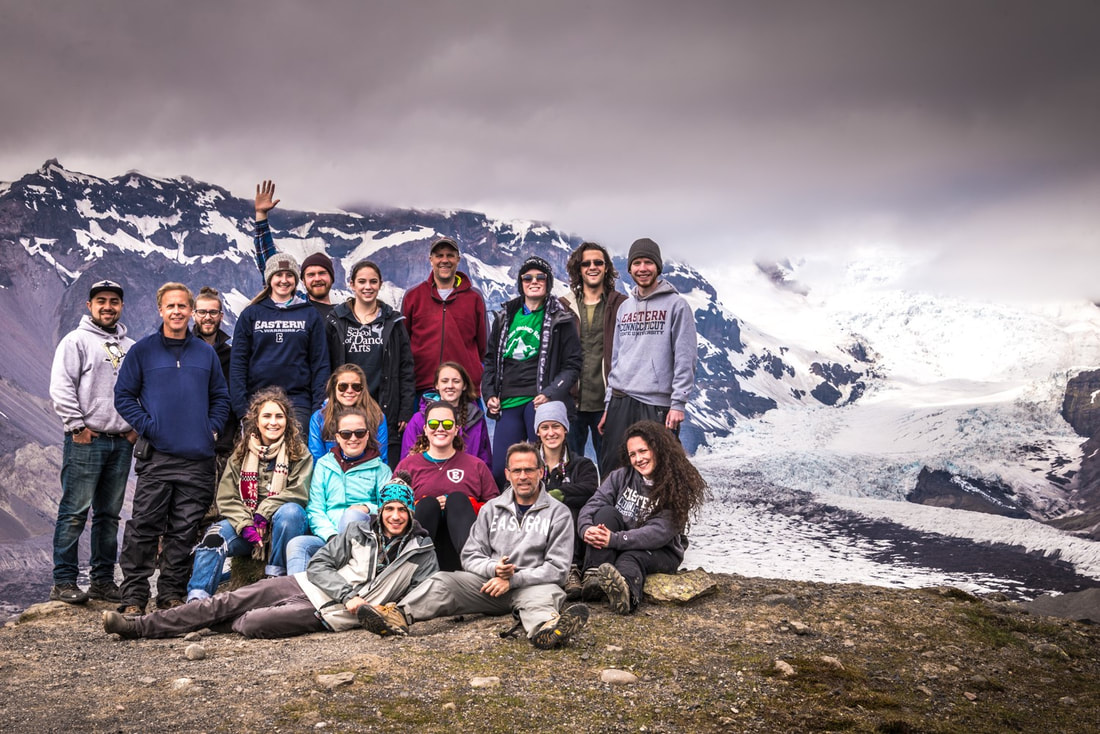
Environmental Earth Sciences students and faculty in front of the Kiviarjokull outlet glacier, Vatnjokull, Iceland
|
|
The Department of Environmental Earth Science at ECSU continues to grow from strength to strength with a number of notable achievements during the last 24 months. We continue to offer a diverse undergraduate curriculum focusing on earth science, sustainable energy and environmental science. As part of our ongoing efforts to develop experiential learning opportunities for our 90-100 majors, we have expanded our undergraduate field-training program. In May 2016, we took 16 students to Iceland for 10 days to investigate the island’s spectacular volcanology, glaciology, geomorphology, active tectonic features and renewable energy industry. The trip included exciting hikes through the Thingvellir rift zone, various geothermal sites, glaciers in Skaftafell National Park, a visit to Heimaey in the Vestmann Islands and a boat ride through the Jökulsárlón ice lagoon. The department also ran a separate 10-day trip in 2017 to Arizona, with visits to many of the state’s geological highlights including the Grand Canyon, the San Francisco Volcanic Field, Sedona, Petrified Forest/Painted Desert, Saguaro National Park, the Santa Catalina Mts, Montezuma Castle, Wupatki pueblo, the Asarco Mining operation south of Tucson and the Jerome mining ‘ghost town’. We now have in place an exciting range of field courses that will rotate in coming years. We are also currently developing new field trips to Spain and New Hampshire/Maine.
Because of the educational value of out-of-classroom learning experiences, we also continue to develop our program of undergraduate research and internship involvement. The Department receives substantial university support to engage our majors in supervised research projects with real-world significance. Ongoing projects include investigating coastal erosion, storm records and shoreline change on the Rhode Island coastline and Block Island (advisors, Oakley, Hyatt, Nathan), the sedimentology, paleo-ecology and geothermal properties of Hartford Basin stratigraphy (advisors: Drewiecki, Nathan, Hyatt), arsenic contamination in eastern CT groundwater (Advisor: Metcalf), litho-tectonic evolution of SE CT bedrock terrain (Cunningham), and sustainable energy use in local communities (Torcellini). In addition, a handful of students hold internships at the ECSU Institute of Sustainable Energy focusing on campus energy use issues. An exciting new collaborative internship program with DEEP has involved more than 12 students in GIS-related land use projects in the last year.
Our students have distinguished themselves at numerous professional conferences in the last 18 months such as GSA, COPLAC, NCUR, and at the annual ECSU undergraduate research conference. Independent faculty research has also published in leading journals and presented at numerous national and international meetings including invited lectures and keynotes at AGU, 50th anniversary of Plate Tectonics meeting in London, SNET (Brazil), and a large number of sustainable energy meetings and workshops including the annual meetings of the Association for the Advancement of Sustainability in Higher Education (AASHE) and the American Society of Heating, Refrigerating, Air-Conditioning Engineers (ASHRAE). Professors Torcellini and Oakley have also recently secured significant external grant funding to support their research into sustainable buildings and coastal geology, respectively.
As the job market evolves, we continue to update our curriculum to meet employer needs. We have recently introduced a new Environmental Health Science minor, revamped the sustainable energy science concentration and developed a new AutoCAD course. Finally, in spring, 2018, we successfully petitioned for a new chapter of the Sigma Gamma Epsilon National Honor Society in the Earth Sciences and in May we will induct our first 17 student members.
|

